 |
 |
 |
 |
 |
 |
 |
 |
 |
 |
 |
 |
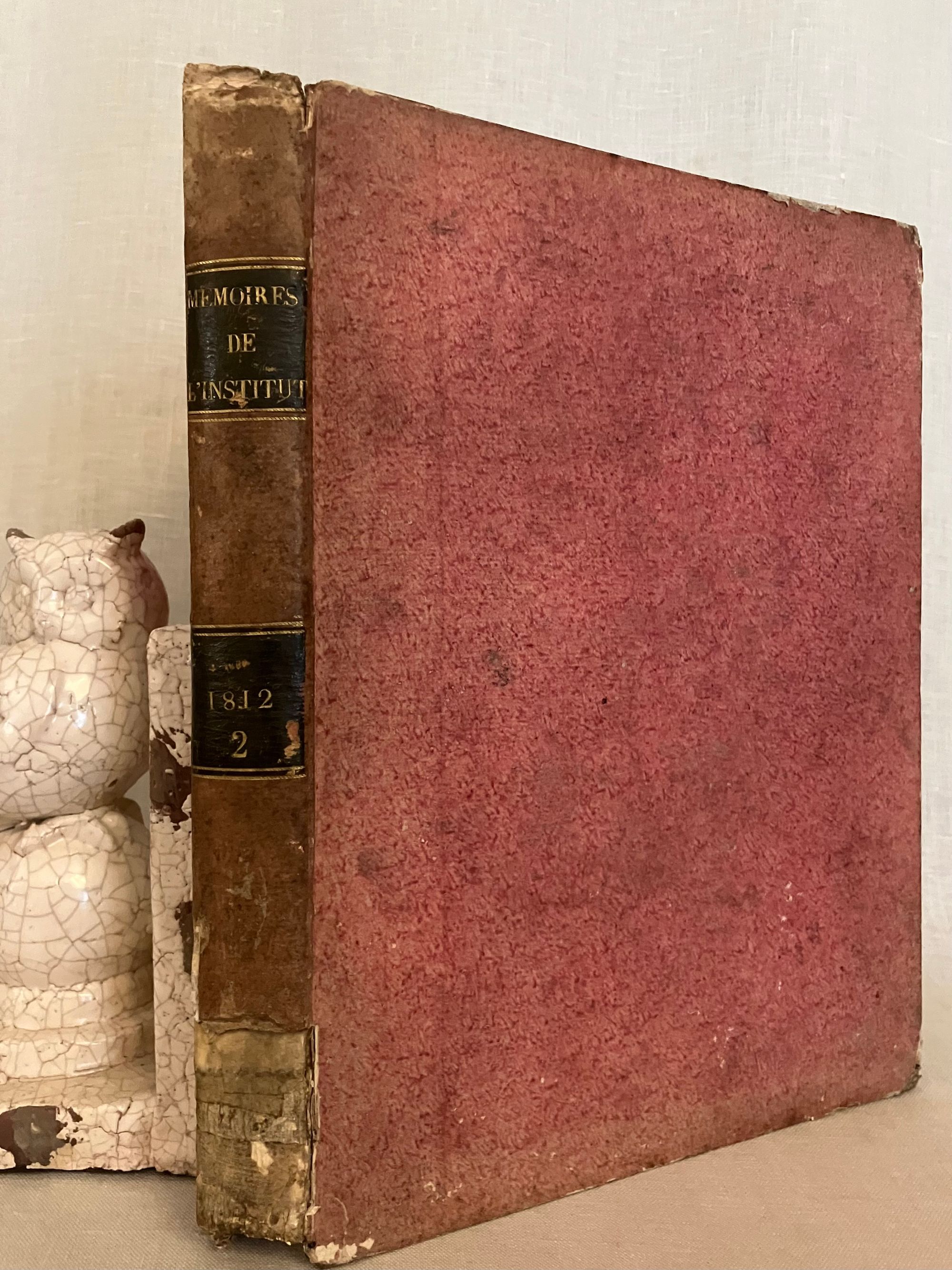
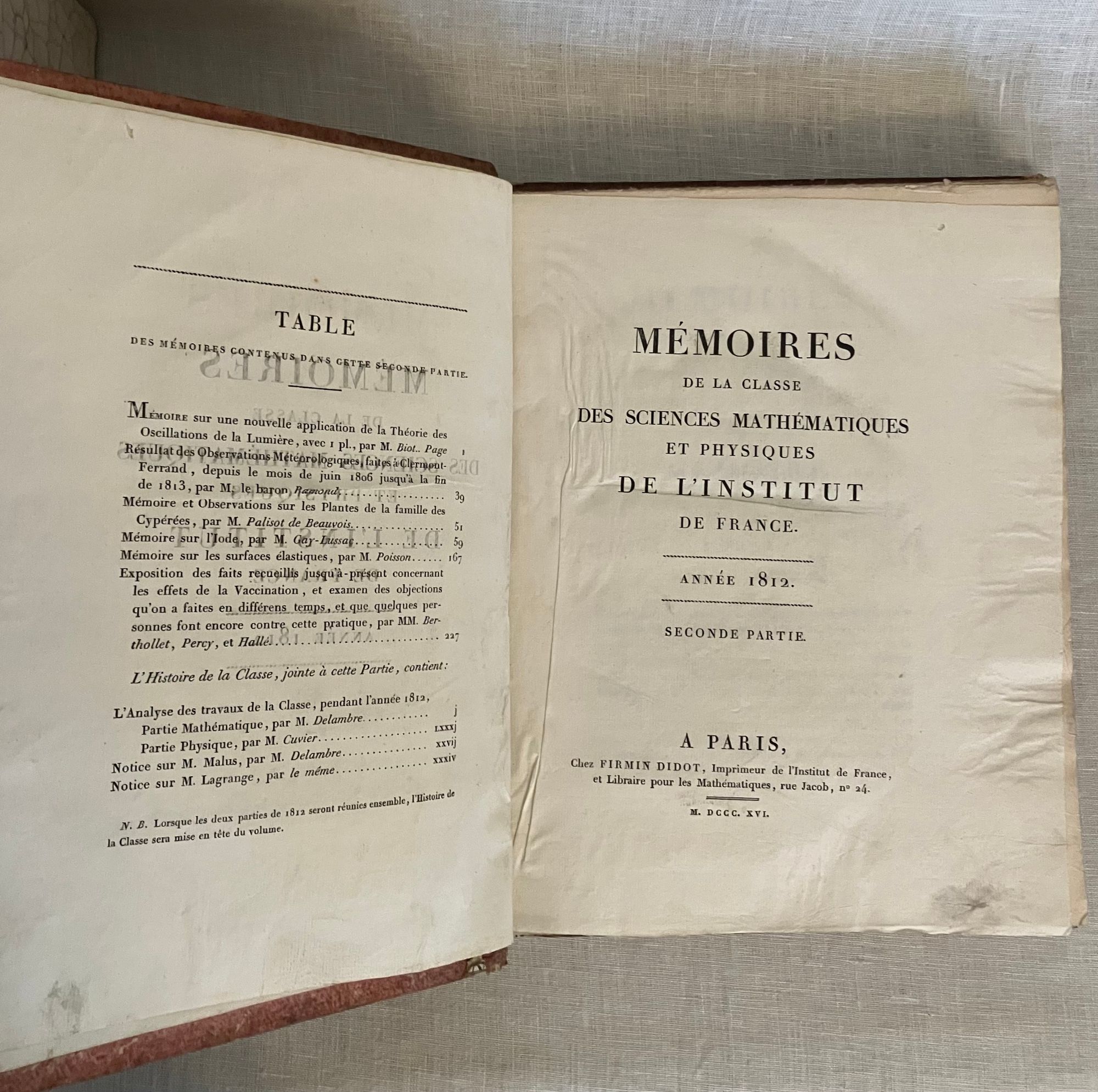
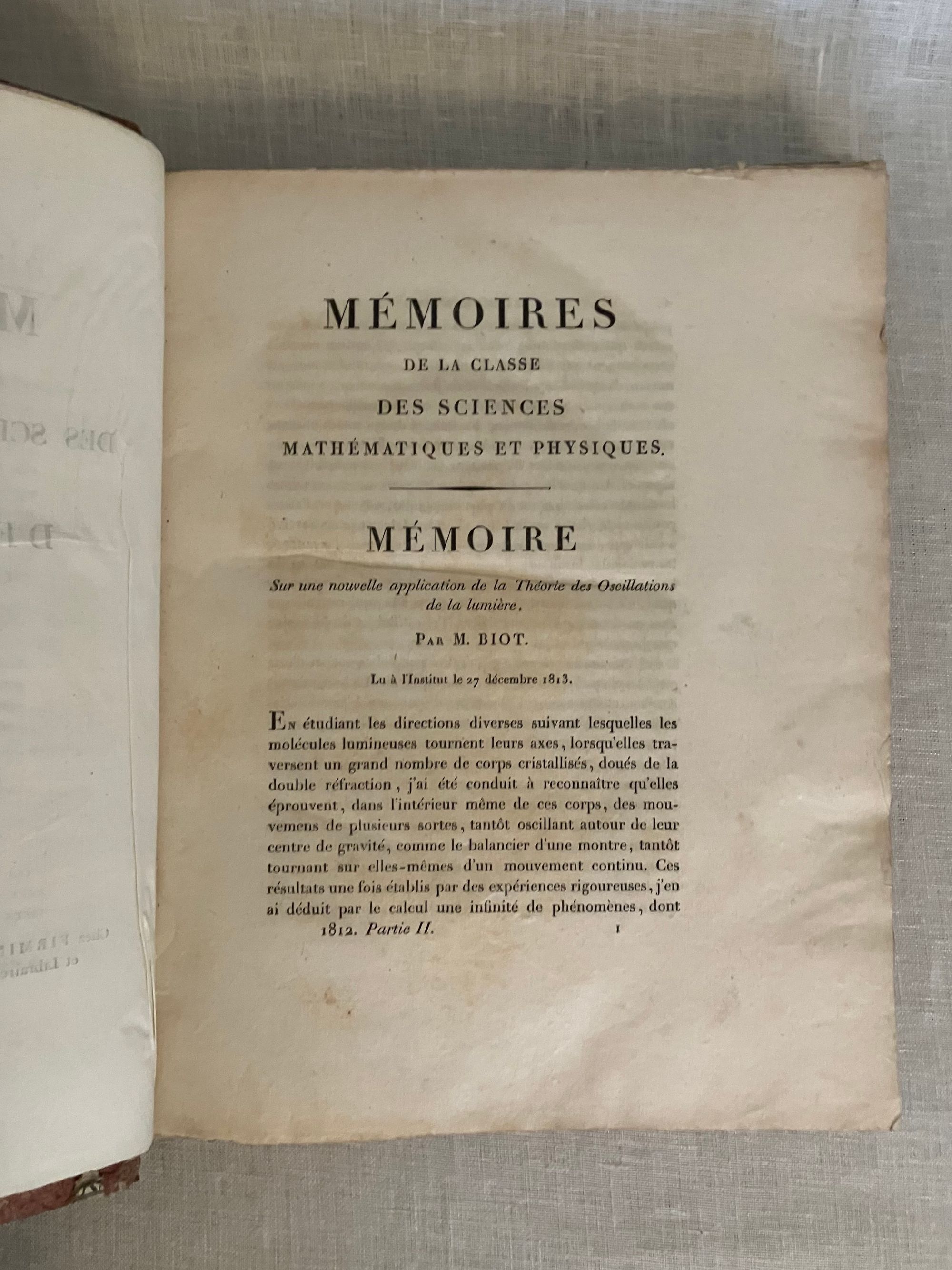
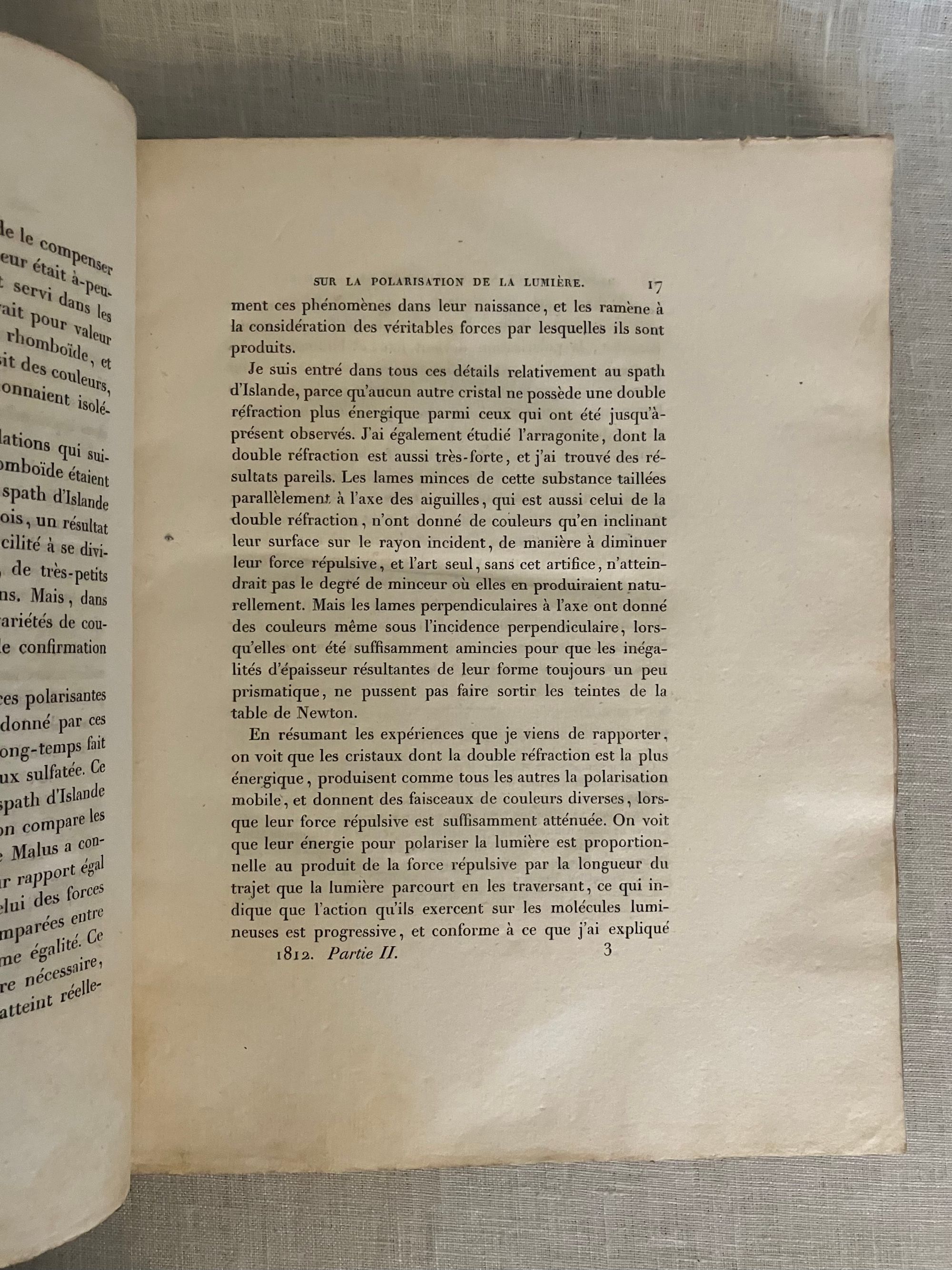
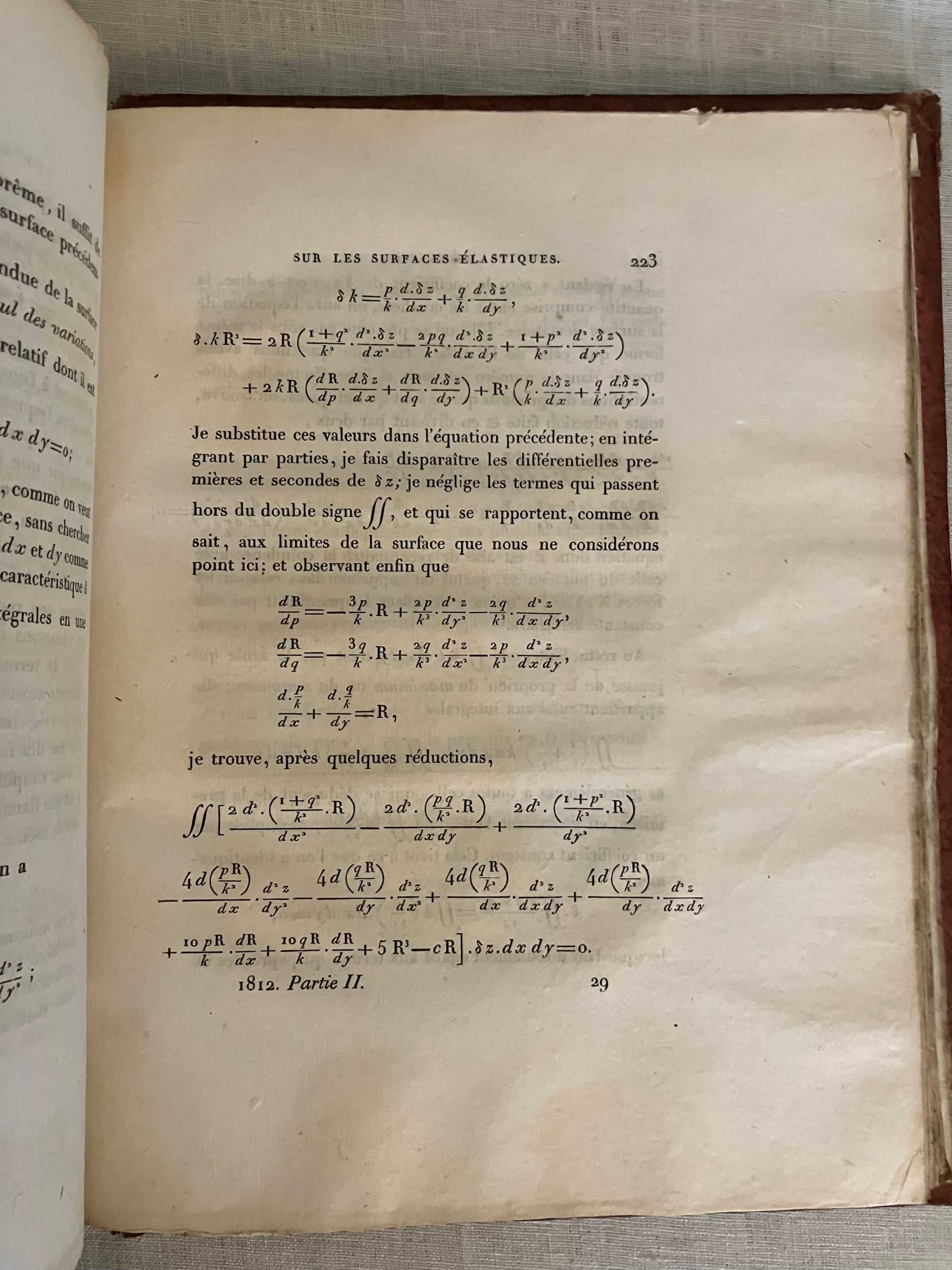
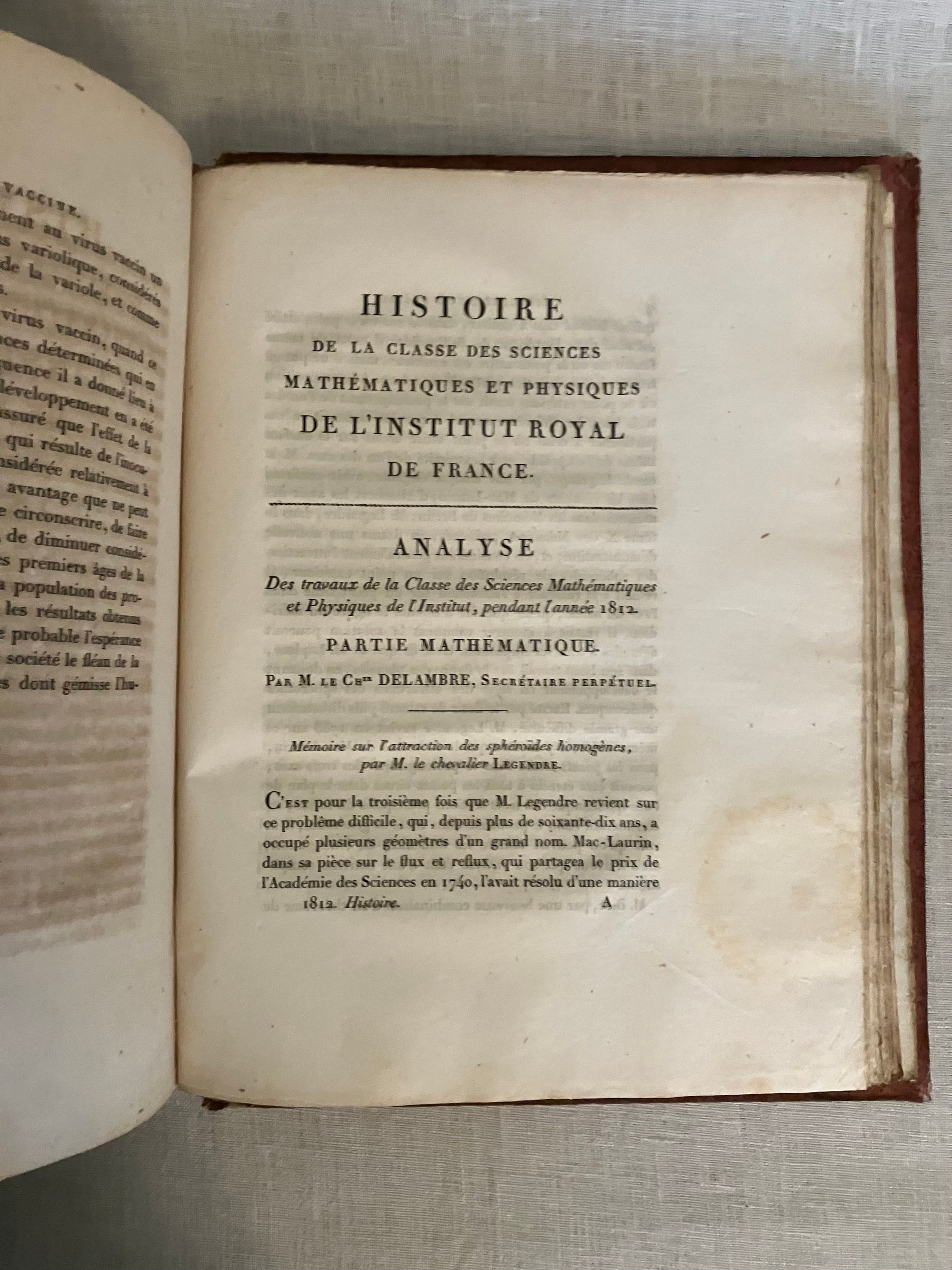
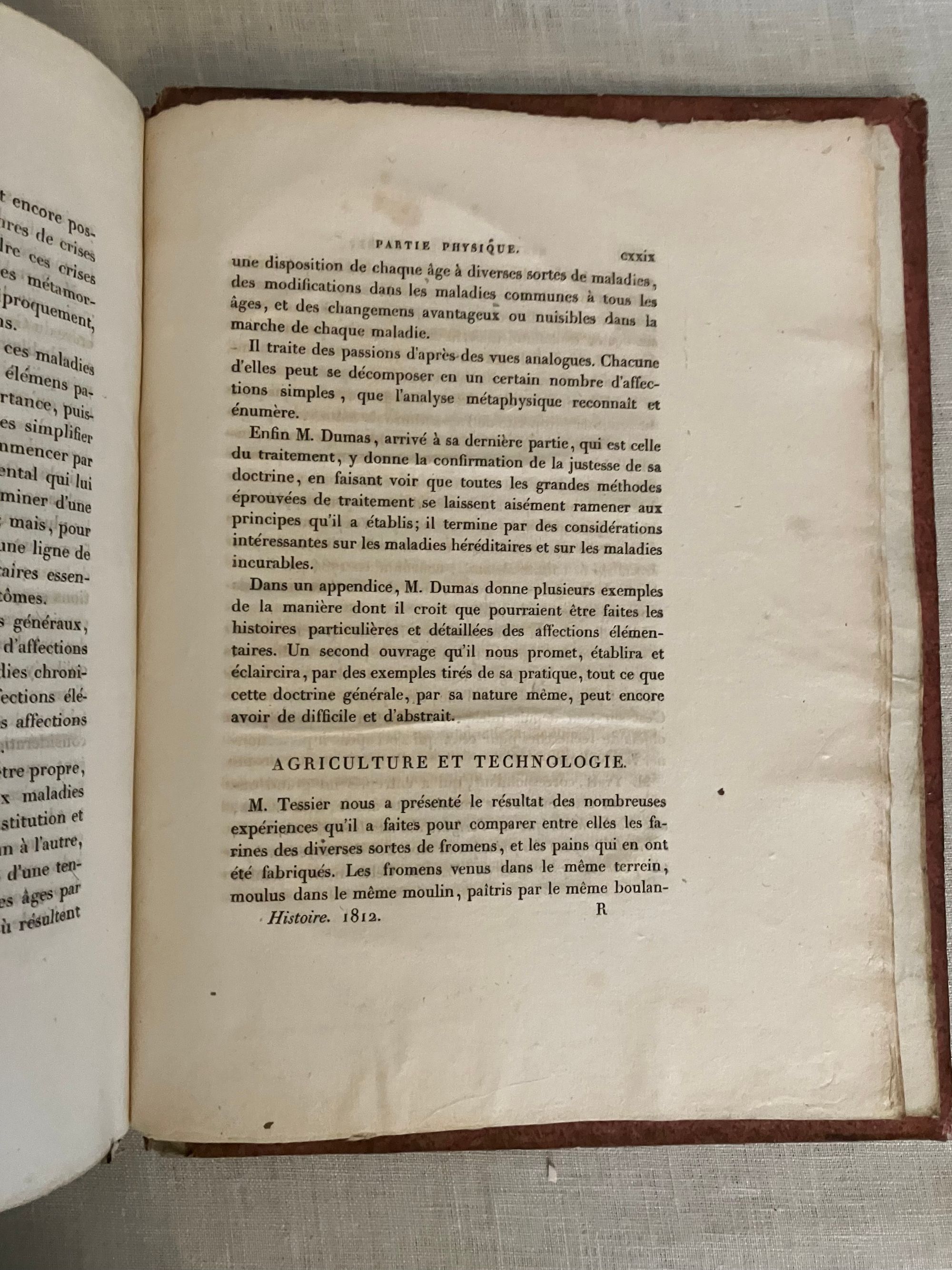


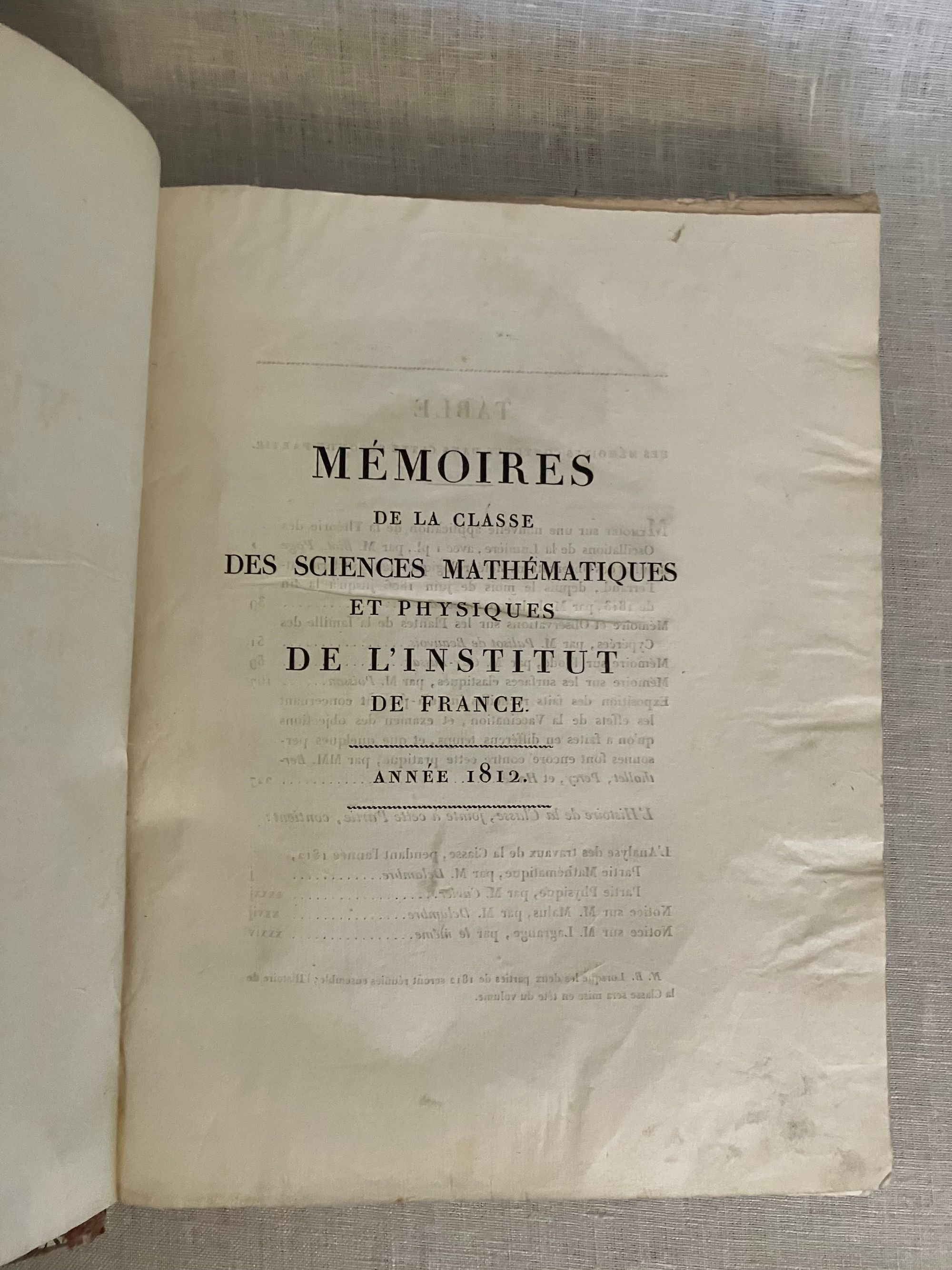
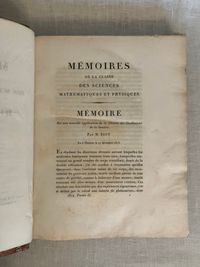
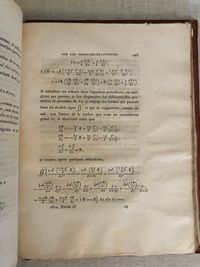
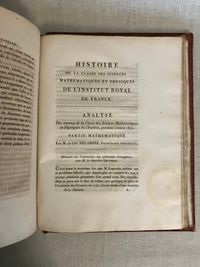
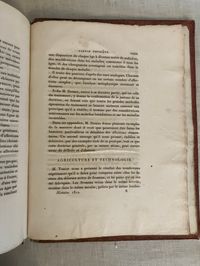
First Edition. French text. Hard cover, quarto, in publisher's paper-covered boards with gilt leather spine labels. Letter press printed on mold made paper. **CONDITION: Very Good Minus. Corners of covers very worn, and pieces missing from foot of backstrip. Internally bright, with light foxing to a few pages only, occasional browning. COLLATION: []x2, 1-36x4 37x2; A4-I4, K4-Q4, R2; [4], 288, cxxxii pp. One foldout illustration. ** A publication of the INSTITUT DE FRANCE. ** CONTENTS: (articles)"Mémoire sur une nouvelle application de la Théorie des Oscillations de la Lumière" (Poggendorff I, 196), by Jean-Baptiste Biot (1774-1862). Biot made discoveries on the polarization of light, proved the existence of meteorites, and studied the effects of elevation on the Earth's magnetic field by taking an daring hot-air balloon trip with his fellow scientist, Joseph Louis Gay-Lussac. He co-authored a study of magnetic field lines with Alexander von Humboldt, and his contributions to magnetism were later recognized in the naming of the Biot-Savart law of magnetism. * "Résultat des Observations Météorologiques, faites à Clermont-Ferrand, depuis le mois de juin 1806 jusqu'à la fin de 1813", by Louis François Élisabeth Ramond, baron de Carbonnières (1755-1827). Ramond was a keen mountaineer, and was one of the first to explore the Pyrenees mountains bordering France and Spain. * "Mémoire st Observations sur les Plantes de la famille des Cypérées", by Ambroise Marie François Joseph Palisot, Baron de Beauvois (1752-1820). Palisot was a French botanist and entomologist who traveled to Africa, Haiti and America to collect and study specimens. He was hit by one disaster after another: the British destroyed his African trading post. Thereafter, he contracted yellow fever and was put on a ship to Haiti. In Haiti, the slave uprising of the Haitian revolution resulted in the loss of his collection to fire, and to his imprisonment. When he was sentenced to deportation, he avoided going to France just after the French Revolution, and instead sailed to America. He was robbed on the journey and arrived in Philadelphia penniless - he was forced to join a circus (as a musician) to provide for himself. He continued his specimen collecting in America, and returned to France with them when it was safe to do so. He sent his collections ahead of his own trip, but they were lost to a shipwreck off Nova Scotia. Nonetheless, he was able to write and publish a number of booklets on his discoveries. * "Mémoire sur l'Iode" (Poggendorff I, 862), by Joseph Louis Gay-Lussac (1778-1850). Gay-Lussac is known for his discovery, with Alexander von Humboldt, that water is made up of one part (by volume) of oxygen to two parts of hydrogen. In 1811, he recognized Iodine as a new element. He was also the co-discoverer of Boron, and the discoverer of the law governing the volume of a gas under constant pressure: "Charles's Law", sometimes known as "Gay-Lussac's Law". * "Mémoire sur les surfaces élastiques", by Baron Siméon Denis Poisson (1781-1840). Poisson was a giant in mathematics, and in mathematical physics, making contributions to the laws of electricity and magnetism, optics, thermodynamics, mechanics, as well as in pure mathematics. In should be noted that, as regards the elastic properties of materials, one major contributor was Sophie Germain (1776-1831). She took up mathematics as an area of study during the French Revolution, when venturing outside the house was dangerous. Her father has an extensive library, and so she was able to study in depth. She gained the friendship and mentorship of Legendre and Gauss, and contributed to the study of the famous "Fermat's Last Theorem". She collaborated with Poisson to edit her scientific paper on the elasticity of materials (Poggendorff I, 884), which was awarded a prize by the Paris Academy of Sciences. * "Exposition des faits recueillis jusqu'à-présent concernant les effets de la Vaccination, et examen des objections qu'on a faites en différens temps, et que quelques personnes font encore contre cette pratique", by Claude Louis Berthollet (1748-1822), Pierre-François Percy (1754-1825) and Jean Noël Hallé (1754-1822). Berthollet was a chemist, known (amongst other things) for his study of the equilibrium of reversible chemical reactions. Percy was a physician who became Napoleon's surgeon-in-chief during the Napoleonic wars, whose battlefield experiences prompted him to invent medical equipment, such an ambulance called a "wurst" which could traverse a battlefield. Hallé was a physician and a pioneer of medical hygiene and its importance in containing contagious diseases. He was also a major proponent of vaccination. ** CONTENTS of "Histoire de la Classe des Sciences Mathématiques et Physiques de l'Institut Royal de France": "L'Analyse des travaux de la Classe, pendant l'année 1812, Partie Mathématique", by Jean Baptiste Joseph Delambre (1749-1822). Delambre was a French astronomer who worked with mathematical analysis. The French authorities had defined the metre as one 10 millionth of the distance from the North Pole to the equator, the "quarter meridian"... but they then had the problem of finding out exactly how long *that* distance was. Delambre was selected to lead the expedition to measure the northern half of the quarter meridian, from Dunkirk to Rodez in the south of France. * "L'Analyse des travaux de la Classe, pendant l'année 1812, Partie Physique", by Jean Léopold Nicolas Frédéric, baron Cuvier (known as Georges Cuvier) (1769-1832). Cuvier was a paleontologist who proposed in his "Essay on the Theory of the Earth" (1813), that disasters such as flooding had wiped out early, now-extinct, species. * "Notice sur M. Malus", by Delambre. * "Notice sur M. Lagrange", by Joseph-Louis Lagrange (1736-1813). Lagrange was a major Italian/French mathematician - who studied the famous "three body problem".R EF: Bibliographie de la France : ou Journal général...No. 2131 (p. 328.)
Ref: SCI 9327
$525.00